AI Tutors for Students, With a Teacher Always in the Loop
College II · Artificial Intelligence & Data ·
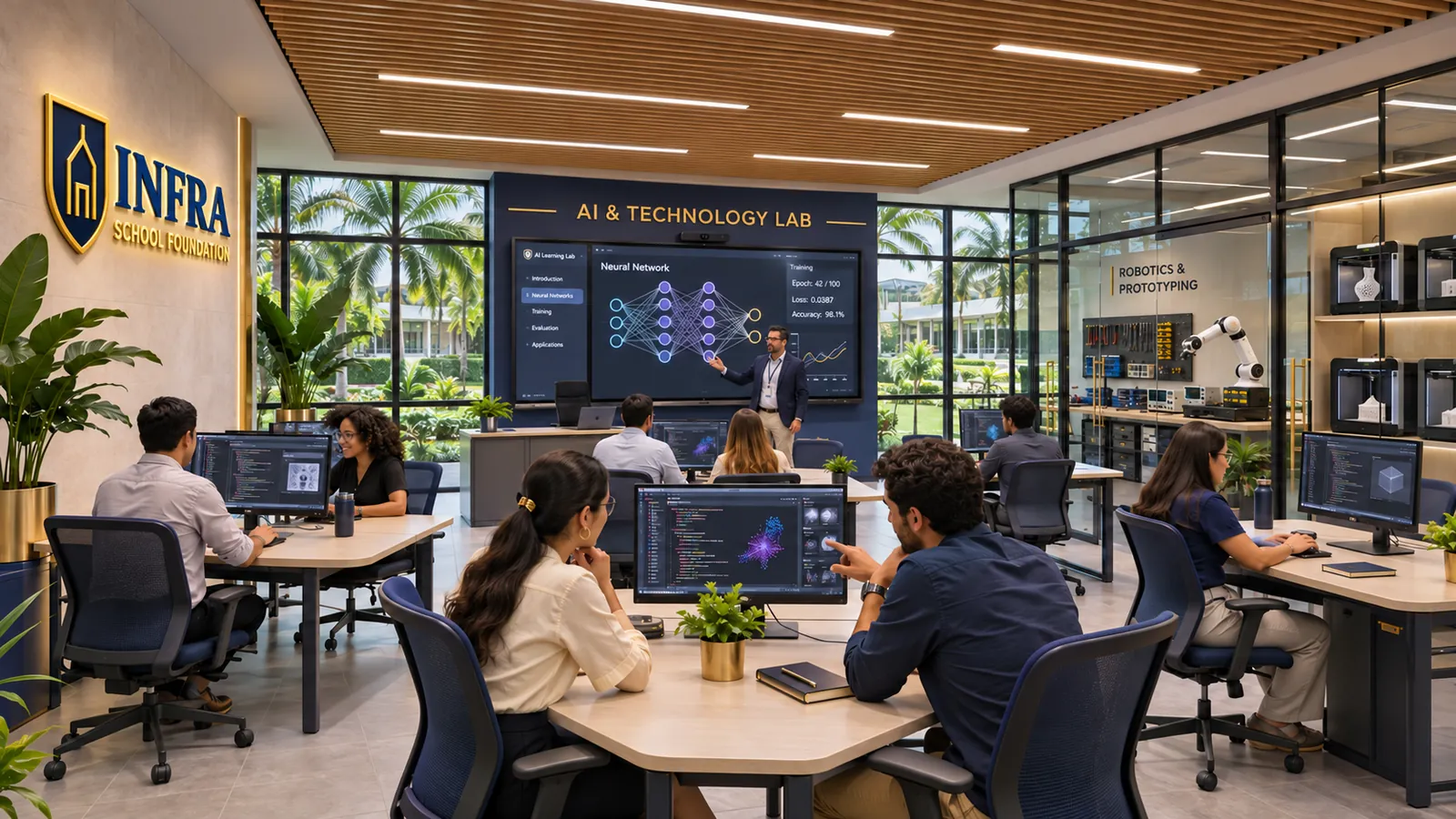
How INFRA School Foundation is designing a personal AI tutor for students aged 15 to 25: hints instead of answers, adapted to each pace, and always with a human teacher in the loop.
Artificial intelligence is already part of how many teenagers study. Some use it well, to understand a difficult idea from a new angle. Others use it to skip the thinking altogether. At INFRA School Foundation we believe AI can be one of the most powerful learning tools ever created, but only if it is designed for learning, and only if a human teacher stays involved. This article explains how we are approaching the personal AI tutor we are building for our students.
First, an honest note on timing. The personal AI tutor is part of a later phase of our platform. It is being designed and built now; it is not yet available to students. What is available today is the learning platform itself: programs, lessons, experience points (XP), levels and the Colleges Cup. We are sharing our approach early because parents, teachers and donors deserve to know how we think about AI before it reaches any student.
Hints, not answers
The easiest thing an AI can do is give the answer. That is also the least useful thing for a learner. If a student is stuck on a loop that never ends, the tutor we are designing should not rewrite the code for them. It should ask a question, point at the line that deserves a second look, or explain the concept in a different way, and then let the student try again.
That principle, hints before answers, is at the centre of the design. The goal is that students leave each session understanding more, not just with a finished exercise. A good human tutor works this way, and our AI tutor should too.
Adapting to each student's pace
Every student learns at a different speed. Some race through the first lessons and get bored; others need to revisit an idea three times before it clicks. One of the reasons we want a personal AI tutor is that it can be available at any hour and adapt its explanations to where each student actually is, so nobody is left behind and nobody is held back.
This matters especially for the Foundation's mission. Many of the young people we want to reach do not have a family member who programs, or the means to pay for private lessons. An AI tutor, used well, can bring patient, personalised help to students who would otherwise study alone.
A teacher always in the loop
AI makes mistakes. It can sound confident and still be wrong, and it can reflect biases present in the data it learned from. We teach this explicitly in AI Explorers, the first program of College II, which includes lessons on spotting AI mistakes and bias and on using AI safely and responsibly. It would make no sense to teach that and then hand students an unsupervised machine.
That is why our approach keeps a human teacher in the loop. Teachers on the platform belong to one of the four Colleges and are approved by the Foundation's staff before they can teach. In our design, the AI tutor supports those teachers rather than replacing them: teachers set the direction of a program, review how students are progressing and remain the people students and families can turn to. The AI handles patient, repetitive explanation; the teacher handles judgement, motivation and care.
Our students are between 15 and 25 years old, and many are minors registered together with a parent or legal guardian. Any AI feature we introduce has to respect that. Before the tutor is released, we will publish clear information about what data it uses, how that data is protected and what limits are in place. College IV, Cybersecurity & Digital Trust, exists precisely because we take these questions seriously, and its standards apply to everything we build.
Learning AI, not just learning with AI
Finally, we do not want our students only to use AI. We want them to understand it and build it. In AI Explorers they learn what AI is, how machines learn from examples and why data is the fuel of AI. In the AI & Data Lab they explore a real dataset, clean and visualise data, build and evaluate their first prediction models and create an AI assistant of their own. The motto of College II is Scientia potentia, knowledge is power, and the knowledge we care most about is knowing how these systems really work.
If you are a student curious about AI, you can start today with AI Explorers on the student portal. If you are a parent or educator and have questions about our approach, write to us through the contact page. We will keep you informed, here on the blog, as the AI tutor moves from design to reality.