Learn to Code and Grow: The Path From Explorer to INFRA Fellow
Editorial team ·
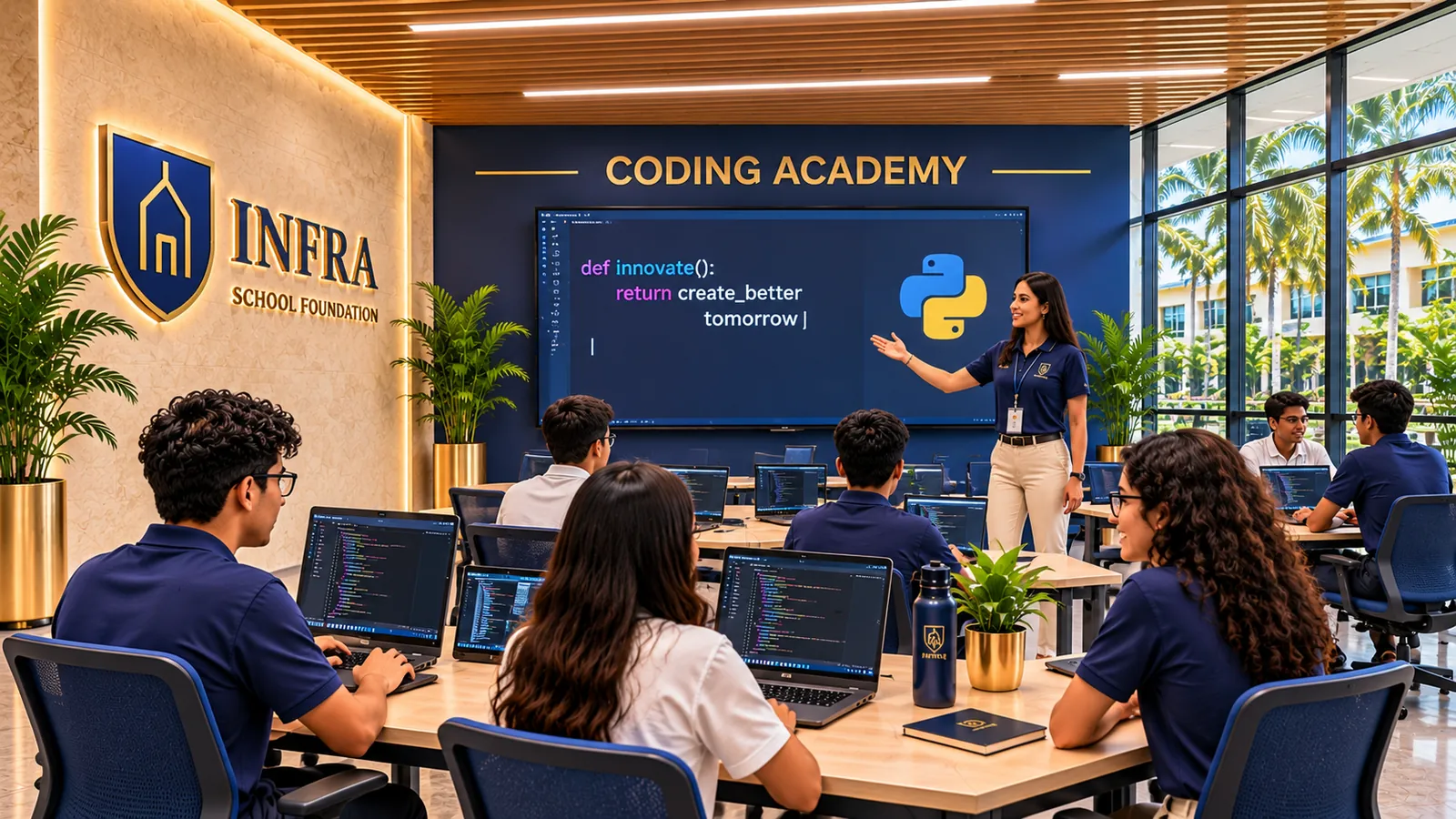
How students learn to code and grow at INFRA School Foundation: the four stages of the Pathway to INFRA, from Explorer to Builder, Architect and INFRA Fellow, plus XP, levels and certificates.
Many young people want to learn to code, but few know what the road looks like after the first tutorial. At INFRA School Foundation we wanted the road to be visible from day one. We call it the Pathway to INFRA: four stages that take a student from their very first line of code to, for the most outstanding, internships and career opportunities across the INFRA Group. This article walks through each stage and explains how a student moves from one to the next.
The Pathway is open to young people aged 15 to 25. Students under 18 are registered together with a parent or legal guardian, who confirms their consent by email before the account is activated.
Explorer and Builder: the first two stages
Every student begins as an Explorer. This stage is about first steps in logic, code and digital creativity. You do not need any previous experience. Each of the four Colleges offers an Explorer-level program designed for beginners: Code Explorers: Your First App in College I, AI Explorers in College II, Digital Money & Blockchain Basics in College III and Cyber Guardians in College IV.
Each program has eight lessons. In Code Explorers, for example, students start by learning to think like a programmer, write their first lines of code, work with variables, decisions and loops, design the screens of an app, make it interactive, save data and, finally, publish their first app.
When a student completes their first full program, they become a Builder. This stage is about real projects inside your College, with a personal mentor. It also unlocks the Builder-level programs: the AI & Data Lab in College II, where students explore real datasets, train their first models and build an AI assistant, and Build on the Blockchain in College III, where they write, test and deploy smart contracts on a public network.
Moving up is not a reward for speed. It is a sign that a student has finished something from beginning to end, which is one of the most important habits an engineer can have.
Architect and INFRA Fellow
After completing three programs, a student becomes an Architect. This stage is about advanced work on the same technologies INFRA runs in production. It unlocks the most demanding programs: Full-Stack Web Engineering in College I, which covers how the web really works, APIs, databases, authentication, testing and deployment, ending with a complete platform as a capstone; and the Ethical Hacking & Security Lab in College IV, where students learn to find and fix vulnerabilities in a safe lab and write a professional security report.
Architects are students who can work across disciplines. By this stage, most will have completed programs in more than one College, which is exactly what real technology teams need.
The final stage is different. INFRA Fellow is not reached automatically by completing more programs. It is granted by the Foundation's staff, by invitation, to the most outstanding students, and it opens the door to internships and career opportunities across the INFRA Group. The selection criteria for internships are being defined together by the Foundation and the INFRA Group, and we will publish them before the first Fellows are invited.
We want to be clear with families: becoming a Fellow is an opportunity, not a promise. What we promise is that every student, at every stage, will receive serious teaching and a fair chance to show what they can do.
XP, levels and certificates along the way
Alongside the four stages, the platform tracks progress in smaller steps. Every lesson completed earns 50 experience points (XP), and every 250 XP a student goes up one level. Students can also keep a daily streak, which rewards steady practice over occasional bursts. Every lesson also adds points to the student's College in the Colleges Cup, a live ranking in which the four Colleges compete throughout the year.
When a student finishes a program, the platform automatically issues a certificate. In a later phase we plan to make these certificates verifiable on a blockchain, so that any school or employer could check them in seconds. That feature is being built and is not yet available.
The best way to understand the Pathway is to take the first step. Create your account on the student portal, choose a College and begin an Explorer program. If you are a parent, you will be asked to register alongside your teenager and confirm by email. And if you are a donor, remember that a scholarship can be the difference between a talented student starting the Pathway or never knowing it existed. Our first scholarship intake opens on 15 February 2027.