What Is Tokenization? Blockchain for Beginners, Explained Simply
College III · Blockchain & Digital Finance ·
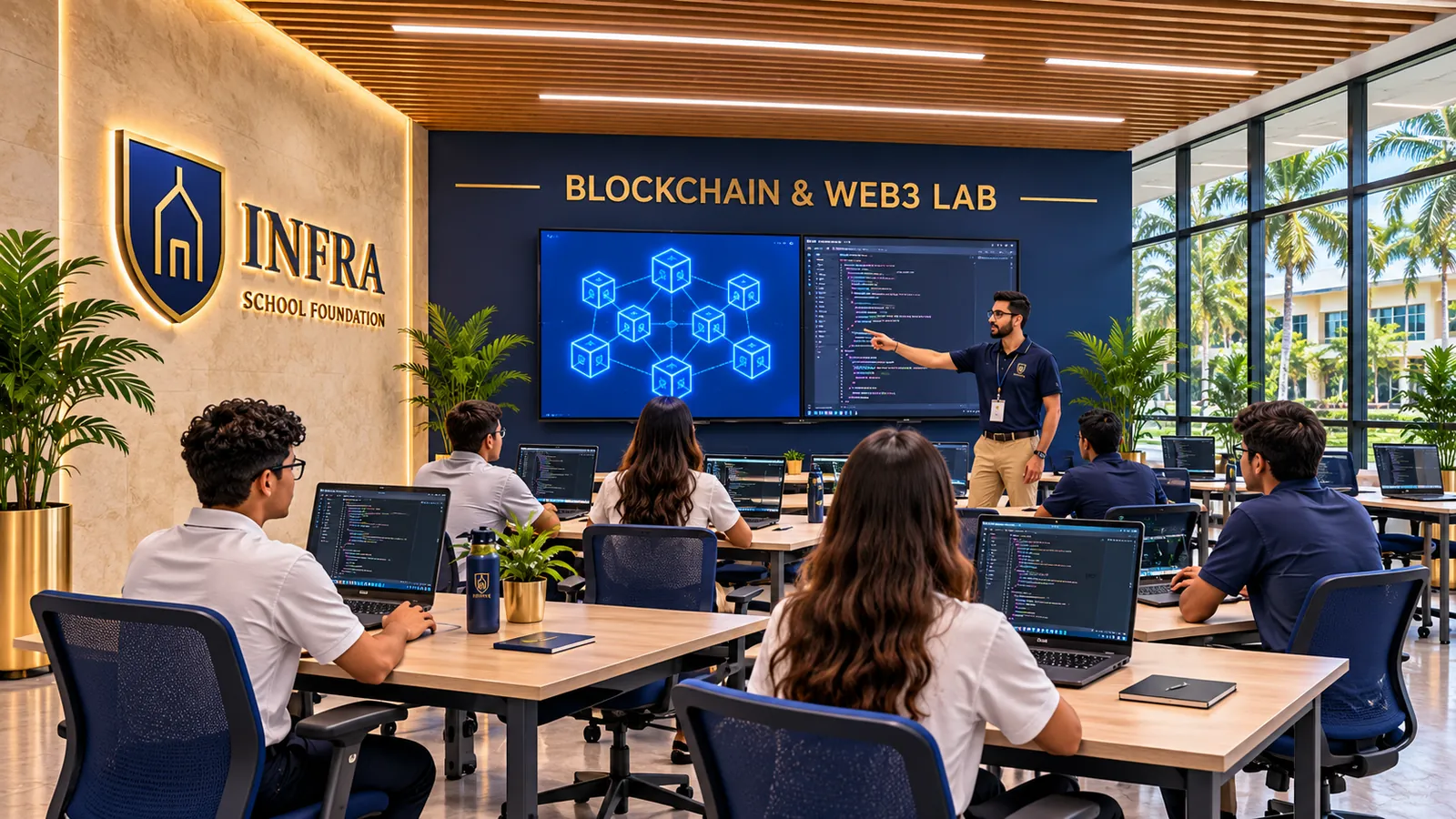
Tokenization explained for teenagers and beginners: what a token is, how a blockchain keeps a shared ledger, and why the tokenized economy needs well-trained young engineers.
You have probably heard the word "tokenization" in the news, often next to words like blockchain, crypto or digital assets. It can sound like something only bankers and programmers understand. In reality, the core idea is simple enough to explain to a fifteen-year-old, and that is exactly what we do in College III, Blockchain & Digital Finance. This article is a first taste of that journey.
Start with money and records
Before talking about tokens, think about what money really is. When you pay for something with a card, no coins move. What changes is a record: a number goes down in your account and up in someone else's. Banks, payment companies and governments keep those records, and we trust them to keep them correctly.
Now imagine a record that is not kept by one single company, but shared by many computers at the same time. Every time something changes, those computers agree on the new version, and once a change is accepted it is very hard to alter or erase. That shared, tamper-resistant record is called a ledger, and a blockchain is one way to build it. Changes are grouped into blocks, each block is linked to the previous one, and the network follows a set of rules, called consensus, to decide which blocks are valid.
So what is a token?
A token is an entry on a blockchain that represents something. It can represent a unit of digital money, a membership, a ticket, a certificate or a share of something valuable. Whoever controls the right digital key can move the token to someone else, and the blockchain records the transfer for everyone to verify.
Tokenization is the process of representing a real-world asset or right as a token on a blockchain. Instead of a paper document stored in a drawer, ownership is written into a shared ledger. That can make transfers faster, records more transparent and certain processes easier to automate.
Some tokens are designed to keep a stable value. Stablecoins such as USDC and USDT, for example, are designed to track the value of the US dollar. Others, like ETH on the Ethereum network or BTC on the Bitcoin network, are the native currencies of their own blockchains, and their value moves up and down.
Smart contracts: rules written in code
Tokens become really interesting when combined with smart contracts. A smart contract is a small program that lives on a blockchain and runs exactly as written. It can say, for example, "when this condition is met, send this token to that address". Nobody can quietly change the rules afterwards, which is why the motto of College III is Fides in catena, trust in the chain.
But code that cannot be changed must be written very carefully. A bug in a smart contract can be expensive. That is why our programs spend real time on testing, security patterns and audits, not only on writing contracts.
Why it matters for young people
The INFRA Group works in this space through platforms such as INFRACOINN, and College III exists so that young people can understand the tokenized economy before they are asked to use it, invest in it or build it. Our first program, Digital Money & Blockchain Basics, starts with how money, banks and payments work, then moves to the idea of a shared ledger, blocks and consensus, wallets and keys, tokens and digital assets, and how to stay safe with digital money. The second program, Build on the Blockchain, is for students ready to write, test and deploy smart contracts on a public network and to connect a web app to a contract.
A word of caution, because we care about our students: learning how tokens work is not the same as speculating with them. Our programs teach technology, risk and safety. They are not financial advice, and we never ask students to buy or trade any asset.
If this article made you curious, the best next step is to create an account on the student portal, choose College III and begin with the first lesson. Students aged 15 to 25 can join; if you are under 18, a parent or legal guardian will register with you and confirm by email. Every lesson you complete earns XP for you and points for your College in the Colleges Cup.
And if you are a parent wondering whether your teenager should learn about blockchain at all, our view is simple: the best protection against confusion and scams is understanding. Knowing how a ledger, a key and a contract work makes a young person much harder to fool.